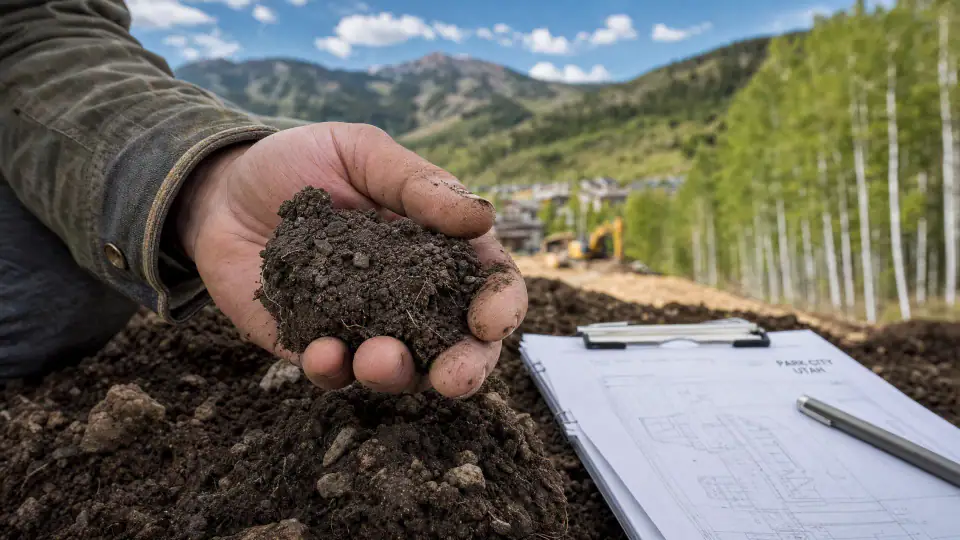
Park City's soil ordinance is one of those regulations that catches first-time builders off guard. If you're buying land or planning a custom home in the Park City Municipal limits, understanding this ordinance isn't optional — it directly impacts your timeline, your budget, and the engineering of your foundation. Here's what you need to know.
What the Ordinance Requires
Park City's soil ordinance (Title 11, Chapter 15 of the Municipal Code) was established to address the unique geological conditions of the Wasatch Mountains. The area's combination of clay-heavy soils, steep slopes, high water tables, and historic mining activity creates real construction challenges that the ordinance aims to manage proactively.
At its core, the ordinance requires:
- A geotechnical investigation report prepared by a licensed geotechnical engineer before any building permit is issued
- Soil stability analysis including bearing capacity, settlement potential, and slope stability
- An erosion control and stormwater management plan for the construction period
- Specific foundation design recommendations based on actual site soil conditions
- Ongoing inspection during excavation to verify that conditions match the geotechnical report
- Revegetation and permanent erosion control measures after construction
Why It Exists: The Geological Reality
Park City sits on some of the most geologically complex terrain in Utah. The area's mining history left behind unstable voids, backfilled shafts, and contaminated soils. Beyond the mining legacy, the natural geology presents its own challenges: expansive clay soils that swell and shrink with moisture changes, shallow bedrock that requires blasting or mechanical breaking, high seasonal water tables from snowmelt, and slopes that are marginally stable without proper engineering.
Without the ordinance, builders might pour standard foundations on soils that can't support them, cut into slopes without understanding the failure planes, or disturb mining remnants that release contaminated materials. The ordinance exists to prevent expensive failures and protect both individual homeowners and the broader community.
How It Affects Your Timeline
The geotechnical investigation alone typically takes 4–8 weeks from engagement to final report. This includes:
Total impact: 6–12 weeks added to your pre-construction timeline. This is why we include geotechnical coordination as one of the first steps in our preconstruction planning phase — so it runs in parallel with design development rather than holding up the permit application.
How It Affects Your Budget
The direct costs of compliance are relatively modest:
- Geotechnical investigation: $8,000–$25,000 (depending on site complexity and number of borings)
- Erosion control plan preparation: $3,000–$8,000
- Erosion control implementation (silt fencing, wattles, inlet protection): $5,000–$15,000
- Additional inspections during construction: $2,000–$5,000
However, the indirect costs can be much larger. If the geotechnical report reveals problematic soils — expansive clays, high water table, or unstable slopes — the foundation engineering becomes more complex and expensive. Deepened footings, caissons, soil stabilization, or specialized drainage systems can add $50,000–$200,000+ to the foundation scope. This is exactly why we insist on getting the geotech done early: it's far cheaper to redesign a foundation on paper than to discover problems during excavation.
Common Soil Conditions in Park City
Based on our experience building across the Park City area, here are the most common soil conditions and their implications:
Expansive Clay
High ImpactSwells when wet, shrinks when dry. Requires deepened footings below the active zone, void forms under grade beams, and careful moisture management around the foundation perimeter.
Shallow Bedrock
Moderate–High ImpactRequires mechanical breaking or blasting for excavation. Adds cost but provides excellent bearing capacity once reached. Common in upper Deer Valley and Thaynes Canyon.
High Water Table
High ImpactRequires waterproofing systems, sump pumps, and potentially French drain systems. Basement construction becomes significantly more complex and expensive.
Fill Soils / Mining Remnants
Very High ImpactUnpredictable bearing capacity. May require removal and replacement with engineered fill, or deep foundation systems that bypass the fill entirely.
Collapsible Soils
Moderate ImpactLose strength when saturated. Common in some lower-elevation areas. Require moisture barriers and controlled drainage to prevent settlement.
How to Plan Around It
The soil ordinance doesn't have to be a roadblock — it just needs to be planned for. Here's how we handle it at Three Peak:
- 1.Engage geotech early
We coordinate the geotechnical investigation during the first weeks of preconstruction, before design is finalized. This gives the architect real data to design around rather than assumptions to redesign later.
- 2.Build findings into the budget
Whatever the geotech reveals, we incorporate it into the low/likely/high estimate range immediately. No surprises during excavation.
- 3.Design the foundation to the site
Rather than designing a standard foundation and hoping the site cooperates, we design the foundation system specifically for the conditions the geotech report identifies.
- 4.Plan erosion control from day one
We include erosion control setup in the site mobilization schedule and budget — not as an afterthought when the inspector shows up.
- 5.Maintain compliance throughout
Erosion control isn't a one-time installation. We maintain it throughout construction, especially during the spring snowmelt period when most violations occur.
The Bottom Line
Park City's soil ordinance adds cost and time to every project — typically $15,000–$50,000 in direct costs and 6–12 weeks to the pre-construction schedule. But it exists for good reason, and a builder who plans for it properly can minimize its impact on your overall project. The worst outcome is discovering soil problems after you've already started excavation, when redesigning the foundation costs 3–5x more than getting it right from the beginning.
This is one of many reasons we advocate for a thorough preconstruction planning phase before committing to a construction contract. The upfront investment in planning pays for itself many times over when it prevents costly mid-construction surprises.
Next Step
Building on a challenging site?
We specialize in complex sites that other builders avoid. Let's talk about your lot and what it'll take to build on it properly.
Schedule a Consultation