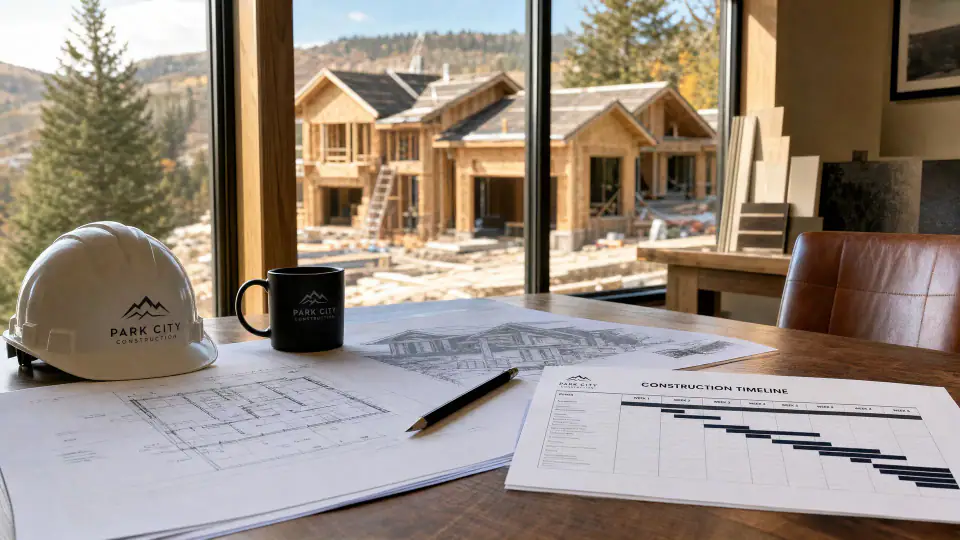
"How long will it take?" is the second question every client asks (right after "how much will it cost?"). The honest answer for a custom home in the Park City area: 14–24 months from first conversation to move-in, with most projects landing in the 16–20 month range. Here's a realistic breakdown of where that time goes — and the delays most builders won't tell you about until you're already committed.
The Full Timeline: Month by Month
We break the custom home timeline into four major phases. Each has its own variables, but together they form the complete picture from "I want to build" to "I'm moving in."
Phase 1
Preconstruction Planning — Months 1–4
This is where most of the critical decisions happen — and where most builders rush through or skip entirely. At Three Peak, our paid planning phase covers:
Initial consultation, site visit, lot analysis, geotechnical investigation ordered, architect selection/engagement, preliminary budget discussion
Schematic design development, geotechnical report received, preliminary engineering, soil ordinance compliance planning, HOA/DRC pre-submission meeting (if applicable)
Design development, material selections begin, detailed cost estimating with trade partners, structural engineering, MEP design coordination
Construction documents finalized, final budget presentation (low/likely/high), permit application submitted, DRC submission (if applicable), construction contract execution
Note: If building in a design-reviewed community like Deer Valley, add 2–4 months for the architectural review process.
Phase 2
Site Work & Foundation — Months 5–7
Once permits are in hand, construction begins with the most weather-dependent and site-specific work:
Site mobilization, erosion control installation, tree protection, excavation begins, utility trenching, retaining walls (if needed)
Foundation forming and pouring, waterproofing, backfill, underslab plumbing and electrical rough-in, garage slab
Foundation curing, framing lumber delivery, subfloor installation, framing begins on lower level
Critical variable: Rock excavation can add 2–4 weeks and $50,000–$200,000+ to this phase. This is why the geotechnical report during preconstruction is non-negotiable.
Phase 3
Framing Through Dry-In — Months 7–11
This is the most visible phase — the house takes shape rapidly. But it's also where coordination between trades becomes critical:
Structural framing (walls, floors, roof), steel beam installation, sheathing, window and door rough openings, deck framing
Roofing installation, window and door installation, exterior weather barrier (house wrap/fluid-applied), exterior stone and siding begins
Mechanical rough-in (HVAC ductwork, radiant tubing), electrical rough-in, plumbing rough-in, insulation, drywall begins
The goal is to be "dried in" (roof on, windows in, weather-tight) before the first heavy snow. If you miss this window, exterior work pauses until spring.
Phase 4
Finishes & Completion — Months 11–16
The finish phase is where the home transforms from a construction site into a living space. It's also the phase most prone to delays from material lead times and change orders:
Drywall finishing, interior painting, cabinetry installation, tile work begins, hardwood flooring acclimation
Countertop fabrication and install, plumbing fixtures, electrical trim (switches, outlets, fixtures), appliance installation, millwork and trim carpentry
Hardwood flooring installation and finishing, final paint touch-ups, hardware installation, closet systems, glass shower enclosures
Final mechanical commissioning, landscaping and hardscaping, driveway and snow-melt activation, punch list, final inspections, certificate of occupancy
The Delays Most Builders Won't Tell You About
Every custom home project encounters delays. The difference between a well-managed project and a nightmare is whether those delays were anticipated and planned for. Here are the most common timeline killers in the Park City area:
Winter Weather Shutdowns
4–12 weeksFoundation and exterior work is extremely difficult from November through March at 7,000+ feet. If your project isn't dried-in before first snow, expect a 3–4 month pause on exterior work.
Permit Processing
4–8 weeksPark City and Wasatch County permit offices are understaffed relative to demand. Plan for 6–8 weeks for permit review, longer during peak building season (spring applications).
Material Lead Times
4–16 weeksCustom windows (Marvin, Loewen): 12–16 weeks. Custom cabinetry: 8–12 weeks. Natural stone: 6–10 weeks. Steel beams: 4–8 weeks. These must be ordered months before they're needed on site.
Subcontractor Availability
2–6 weeksSummit County has a limited pool of qualified trades. During peak season (May–October), the best electricians, plumbers, and HVAC contractors are booked 4–6 weeks out.
Design Changes During Construction
2–8 weeks per changeEvery mid-construction change requires re-engineering, re-pricing, re-scheduling, and often re-permitting. The single biggest cause of timeline overruns.
Inspection Scheduling
1–3 weeks per inspectionRequired inspections (foundation, framing, mechanical, insulation, final) must be scheduled with the county. During busy periods, inspectors may be booked 1–2 weeks out.
How to Protect Your Timeline
The projects that finish on time share common characteristics. Here's what we do at Three Peak to protect the schedule:
- 1.Complete all design decisions before breaking ground
Our preconstruction phase requires that every material, fixture, and finish is selected and ordered before construction begins. No "we'll figure it out later" on critical-path items.
- 2.Order long-lead materials immediately after contract signing
Windows, steel, custom cabinetry, and specialty stone are ordered 4–6 months before they're needed on site. This eliminates the most common material delay.
- 3.Build weather contingency into the schedule
We assume 4–6 weeks of weather delays for any project that spans a winter season. If we get lucky with weather, we finish early. If we don't, we're still on schedule.
- 4.Lock in subcontractor schedules early
We confirm trade schedules 6–8 weeks in advance and maintain relationships with backup crews for critical-path trades.
- 5.Minimize change orders
The thorough preconstruction process means fewer surprises and fewer mid-build changes. When changes do happen, we assess timeline impact immediately and communicate it clearly.
When to Start If You Want to Move In By a Specific Date
Working backward from common move-in targets:
The best time to start planning is 18–24 months before your desired move-in date. The second-best time is now. Learn more about how our process works and what the first steps look like.
The Bottom Line
A custom home in Park City takes 14–24 months from first conversation to move-in. The single biggest factor in whether you land on the shorter or longer end of that range is the quality of preconstruction planning. Projects that rush into construction without completing design, ordering materials, and resolving site challenges inevitably take longer and cost more. Projects that invest in thorough planning upfront finish on schedule because the surprises have already been identified and solved on paper.
Next Step
Ready to start the clock?
The sooner we start planning, the sooner you're in your new home. Schedule a complimentary walk-through and we'll map out a realistic timeline for your specific project.
Schedule a Consultation