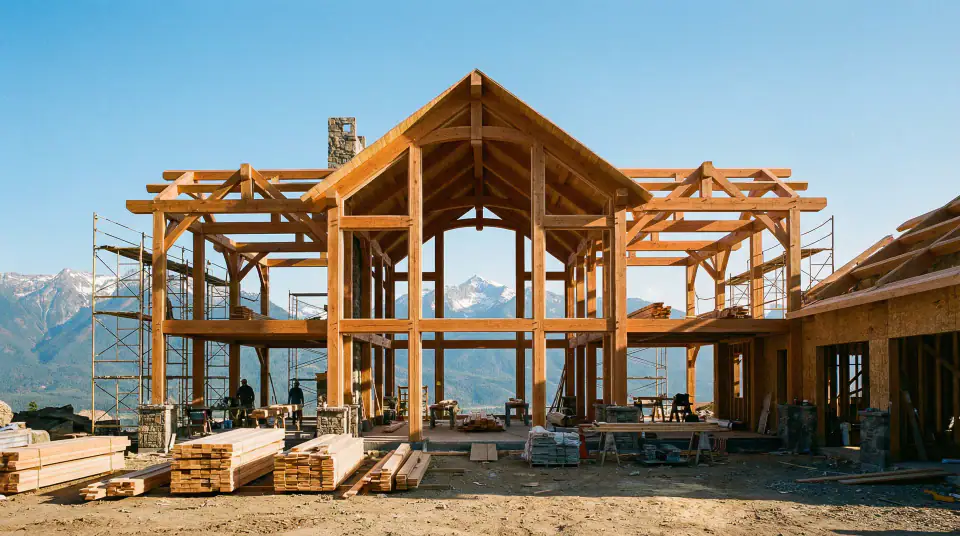
The honest answer: it depends. Not because we're being evasive — because the variables genuinely differ between a hillside lot in Park City, a valley parcel in Heber, an infill build in Draper, and a foothill site in Alpine. This guide breaks down what drives costs in each of the four counties we serve, gives you realistic ranges, and explains why a single "cost per square foot" number is almost always misleading.
Why "Cost Per Square Foot" Is the Wrong Question
Every builder gets asked this question. And every honest builder will tell you it's incomplete. A 4,000 SF home on a flat lot with city utilities costs dramatically less than a 4,000 SF home on a 30% slope requiring a retaining wall, well system, and 200-foot driveway.
The meaningful cost drivers are: site conditions (slope, access, utilities), jurisdiction (permitting fees, impact fees, review timelines), design complexity (rooflines, structural spans, custom details), and finish level (standard vs. premium vs. luxury materials and systems).
That said, ranges are useful for initial planning. Here's what we're seeing across our four-county service area in 2026.
Summit County: $450–$900+ per SF
Summit County remains the most expensive market in our service area. Park City Municipal's design review, steep-slope permitting, and the general cost of doing business at 7,000+ feet all contribute.
Key Cost Drivers — Summit County
- Hillside grading and retaining walls: $50K–$200K+ on steep lots
- Park City design review timeline: adds 6-10 weeks to schedule (carrying costs)
- Impact fees: $15K–$40K depending on jurisdiction and water district
- ARB fees and dual-track approvals in gated communities: $5K–$15K
- Snow load engineering and insulation requirements at elevation
Realistic range: A well-built custom home in Park City or Promontory typically lands between $500–$750/SF for a quality build with premium finishes. Luxury-tier projects with imported materials, complex rooflines, and extensive site work regularly exceed $800/SF.
Wasatch County: $350–$650+ per SF
Wasatch County offers a meaningful cost advantage over Summit County — primarily in land cost, but also in permitting fees and some labor rates. The construction complexity, however, can be comparable on hillside lots.
Key Cost Drivers — Wasatch County
- Well and septic systems on rural lots: $30K–$80K
- Impact fees: $15K–$30K (Heber City vs. unincorporated county)
- Longer utility runs on large parcels
- ARB processes at Benloch Ranch, Red Ledges, Tuhaye
- Geotechnical requirements on hillside lots
Realistic range: Quality custom homes in the Heber Valley typically land between $400–$550/SF. Premium builds in gated communities like Benloch Ranch or Red Ledges run $500–$650+/SF when you factor in ARB-mandated materials and finishes.
Salt Lake County (East Bench): $300–$550+ per SF
Salt Lake County's east bench — Holladay, Millcreek, Cottonwood Heights, Draper — is primarily a remodel and infill market. New construction costs here are generally lower than the mountain communities because of flatter sites, existing utility infrastructure, and faster permitting.
Key Cost Drivers — Salt Lake County East Bench
- Demolition and site prep on infill lots: $20K–$60K
- Existing infrastructure connections (typically available): saves $20K–$50K vs. rural
- Neighbor coordination and access constraints in established neighborhoods
- Hillside overlay zones on upper-bench Draper/Cottonwood Heights lots
- Impact fees: $10K–$25K depending on municipality
Realistic range: Custom infill homes on the east bench typically run $350–$500/SF for quality construction. Upper-bench hillside lots in Draper or Cottonwood Heights with view premiums and geological complexity can push to $500–$550+/SF.
Utah County (Alpine, Highland, Lehi): $300–$500+ per SF
North Utah County's premium corridors offer the most competitive construction costs in our service area — primarily because of flatter building sites, efficient municipal permitting, and a deeper labor pool. But foothill lots in Alpine and Traverse Mountain can approach mountain-community complexity.
Key Cost Drivers — Utah County
- Alpine hillside protection zone: geotechnical + slope stabilization
- Traverse Mountain HOA/ARB: material mandates increase finish costs
- Impact fees: $20K–$35K in Lehi (among the highest in the area)
- Large-lot infrastructure in Alpine: longer utility runs, potential well/septic
- Generally flatter sites = lower site-prep costs than mountain communities
Realistic range: Quality custom homes in Highland and valley-floor Lehi typically run $300–$400/SF. Alpine foothill lots and Traverse Mountain premium builds run $400–$500+/SF with HOA-mandated finishes and hillside engineering.
What These Numbers Don't Include
The ranges above are construction cost — what it costs to build the home itself. They typically don't include:
- Land cost — varies dramatically by location ($200K in Heber to $2M+ in Park City)
- Architecture and engineering — typically 8-12% of construction cost
- Landscaping and hardscaping — $50K–$200K+ depending on lot size and design
- Furniture, fixtures, and equipment (FF&E) — interior design beyond built-in finishes
- Construction financing costs — interest during the build period
How We Budget: Low / Likely / High
At Three Peak, we don't give you a single number and hope it works out. Our preconstruction process produces a three-range estimate — low (everything goes perfectly), likely (realistic with normal contingency), and high (if we hit known risk factors). This gives you a genuine understanding of your financial exposure before you commit.
The "likely" number is what we build the schedule and draw structure around. The "high" number is what you should be financially comfortable with before starting. If we can deliver at the "low" number, we will — but we won't promise it to win the job.
Next Steps
These ranges are useful for initial planning — but your specific project will have its own cost profile based on your lot, your design, and your finish expectations. The fastest way to get a meaningful number is to start a conversation about your specific situation.